
How Streaming Platforms Can Stop Losing Demand and Finally Convert Intent into Subscriptions
When a viewer watches your trailer or sees an ad and then types “[Title] watch online” into Google, they are no longer just browsing — they are in high-intent mode. At that exact moment, the battle for conversion is decided: will they become your subscriber, or will they consume the content for free on a pirate site?
For the past year, Piracymeter has been conducting weekly monitoring of Google search results across 116 countries for hundreds of movies and TV shows. We analyzed the SERPs for two critical localized queries: “[Title] watch online” (streaming intent) and “[Title] download” (torrent intent). In every result set, we measured the share of links offering free illegal viewing or downloading.
Based on this data, we publish a weekly Top 300 Most Pirated Movies & TV Shows report. In addition to analytics, we actively work with rights holders and streaming platforms to protect content in the most challenging regions, including MENA, Eastern Europe, and Latin America.
Here are the key insights every streaming executive should consider when building a global VOD business.
Pirates Are Your Real Competition
In today’s crowded market, streaming platforms don’t just compete with each other. On many territories, your biggest competitor is piracy — because it’s free, immediate, and often offers better perceived accessibility.
High-quality pirated copies (including 4K versions) frequently appear online on the same day as the official premiere — sometimes even hours earlier. Technical protections such as DRM, watermarking, screen recording prevention, and encryption have proven insufficient. We consistently observe new seasons of major Netflix, Amazon Prime Video, and Disney+ titles leaking almost instantly.
The level of piracy visibility in Google search varies dramatically by region. According to our latest report dated April 5, 2026, the average share of pirated links in the Top 10 results breaks down as follows:
- MENA — up to 74%
- APAC — 41%
- Europe — 30%
- LATAM — 26%
- North America — 15%
- Africa — 12%
Certain countries stand out with extreme numbers. Ukraine often exceeds 80% piracy in Top 10, while Egypt can reach 79% in Top 10 and 67% in Top 100.
Even a single pirate link in the Top 10 creates a serious problem. From a CTR and user behavior perspective, it captures significant traffic, offering the content for free. In an environment where subscription prices continue to rise, this becomes a major barrier to acquisition and retention.
Why Traditional Anti-Piracy Approaches Fall Short
Most anti-piracy vendors focus on the volume of links removed. For a streaming platform, however, the only metric that truly matters is how much piracy remains visible at the moment of search intent.
Take Stranger Things as an example. Even this flagship Netflix series saw pirated links occupying up to 36% of Top 10 results and 31% of Top 20 results across multiple countries — capturing a significant share of high-intent traffic at the moment of search.
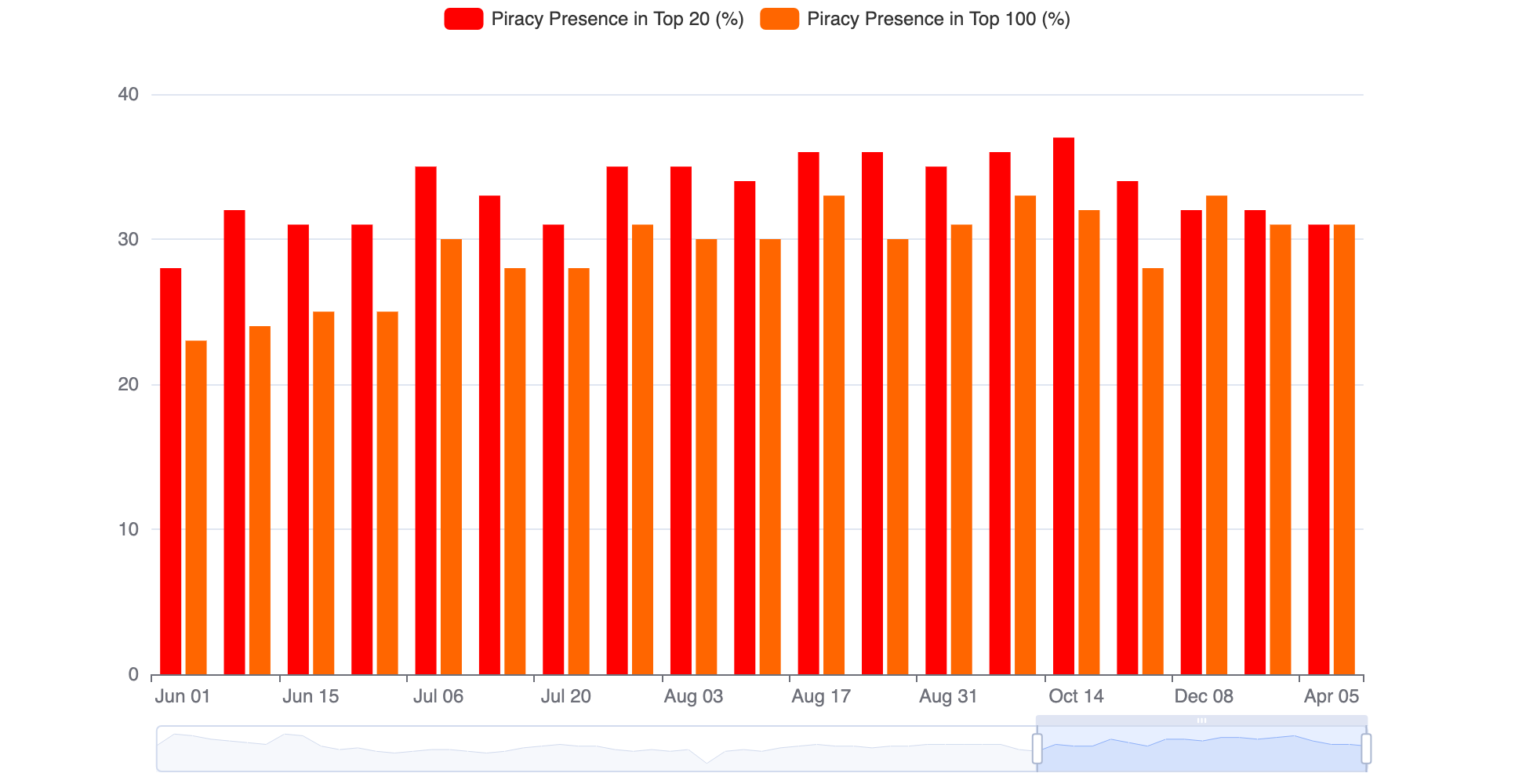
Note: Piracymeter did not provide content protection or enforcement services for Stranger Things. The data shown reflects independent monitoring of piracy visibility in Google Search across 116 countries based on search queries related to online viewing and downloading of the title. The chart is intended solely to illustrate piracy visibility trends over the measured period.
As long as pirates dominate the first page of Google, a meaningful portion of the demand you generate through expensive marketing campaigns leaks straight to illegal sources.
The pirate ecosystem is highly dynamic. Sites constantly shift domains to evade blocks and Google’s pirate filters. While a few “legacy” sites maintain long-term visibility, most rely heavily on search traffic. If you don’t control the first page of results for high-intent queries, you are effectively subsidizing your competitors.
Turning Search Demand into Users
The objective is not simply to reduce piracy.
It is to ensure that search demand converts into users on your platform — not traffic for pirate sites.
In practice, this means controlling what users see at the moment of intent.
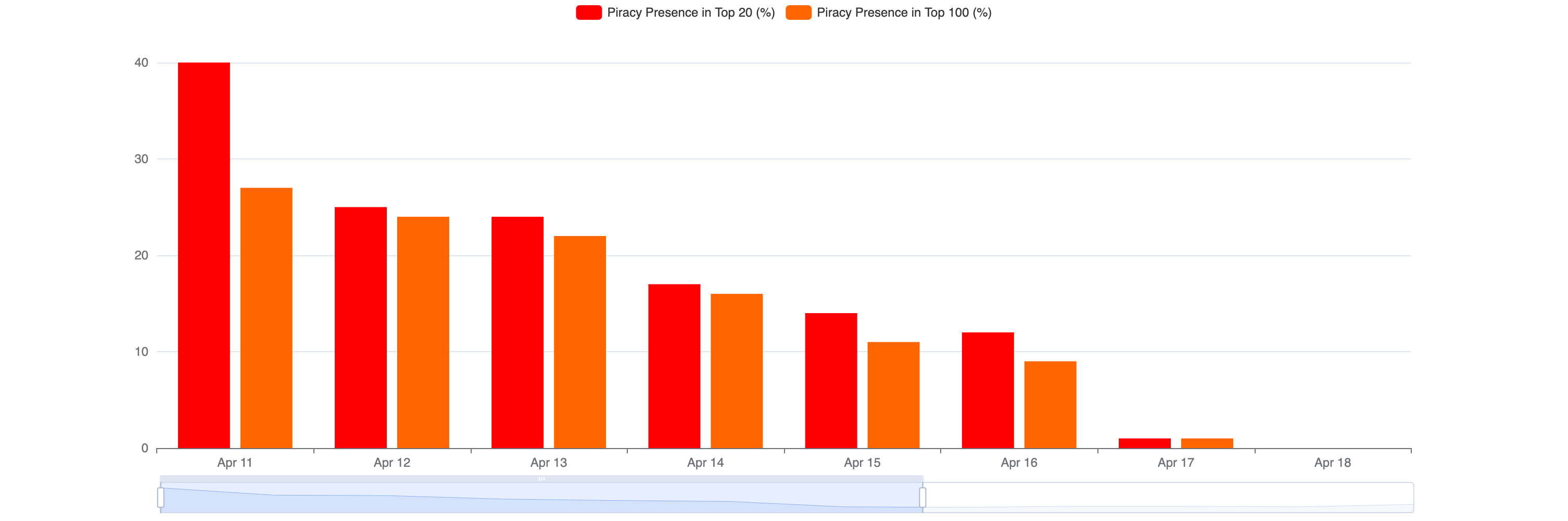
Our experience shows that in most markets, with a structured and continuous approach, piracy visibility in Top 20 search results can be reduced to near-zero within 7–10 days.
The chart below illustrates this effect using Avatar: Fire and Ash, where piracy visibility was systematically eliminated from the positions that drive user decisions.
When Speed Matters: Protecting the Release Window
In many cases, waiting 7–10 days is not an option.
For major releases, the first weekend determines a significant share of total demand, and this is exactly when piracy is most aggressive.
To protect this window, platforms need a more proactive strategy:
- Protection should begin before the premiere, including cleanup of previous seasons, related titles, and franchise content. Pirate sites actively interlink this content, often presenting it as a single entry point (“watch all seasons here”).
- Success must be measured daily, based on how piracy visibility changes in Google search results for specific queries, countries, and languages — not by the number of notices sent.
- Priority should be given to high-intent streaming queries, such as “watch online.” These queries capture users who are ready to watch immediately and represent the most valuable segment for acquisition and conversion..
The Business Impact for Streaming Platforms
When you successfully remove pirates from the top of search results, you achieve several critical outcomes:
- Higher conversion of search traffic into registrations and paid subscriptions
- Reduced churn from users who sampled content illegally
- Significantly improved ROI on ATL and performance marketing campaigns
- Cleaner, more accurate measurement of true marketing effectiveness
Unfortunately, 99% of current anti-piracy programs do not measure what matters most: the visible impact on piracy in Google search results.
At Piracymeter, we built our entire methodology around this exact metric — controlling visibility at the point of intent.
About Piracymeter
With 18 years of experience in online anti-piracy, Piracymeter holds the status of Trusted Flagger under Article 22 of the EU Digital Services Act (DSA), specializing in intellectual property infringements. We are official partners in the Google Trusted Copyright Removal Program (TCRP) and the Microsoft Bing Trusted Partner Program, and maintain direct API integration with Cloudflare for rapid enforcement.
We don’t just remove links — we help streaming platforms and studios systematically reclaim control over search demand, especially in the most difficult territories.
If you’re tired of losing high-intent traffic to piracy and want to see real data on how this affects your titles across key markets, we’d be glad to discuss. Reach out — we can show you concrete numbers and explore how to turn search traffic into a reliable acquisition channel.
Author: Serhii Poloz CEO & Co-founder, Piracymeter
Related Articles
All posts

Ready to Get Started?
No credit card required.